Basic Life Support (BLS): What Everyone Should Know About Saving a Life
A person suddenly collapses.
They are unresponsive.
They are not breathing normally.
What would you do?
In a cardiac arrest, the first few minutes can make the difference between life and death. Advanced medical teams, medications, ventilators and intensive care are important—but they cannot help if effective basic life support is not started early.
Basic Life Support (BLS) is the foundation of resuscitation.
It is not only a skill for doctors, nurses or paramedics. Ordinary people can learn the essential steps of recognizing cardiac arrest, calling for help, performing CPR and using an automated external defibrillator (AED).
The latest American Heart Association guidelines emphasize early recognition, high-quality CPR and rapid defibrillation as key interventions in adult cardiac arrest.
What is Basic Life Support?
Basic Life Support is the immediate care provided to a person who has:
BLS aims to maintain oxygen delivery to the brain and other vital organs until more advanced medical care becomes available.
The core principle is simple:
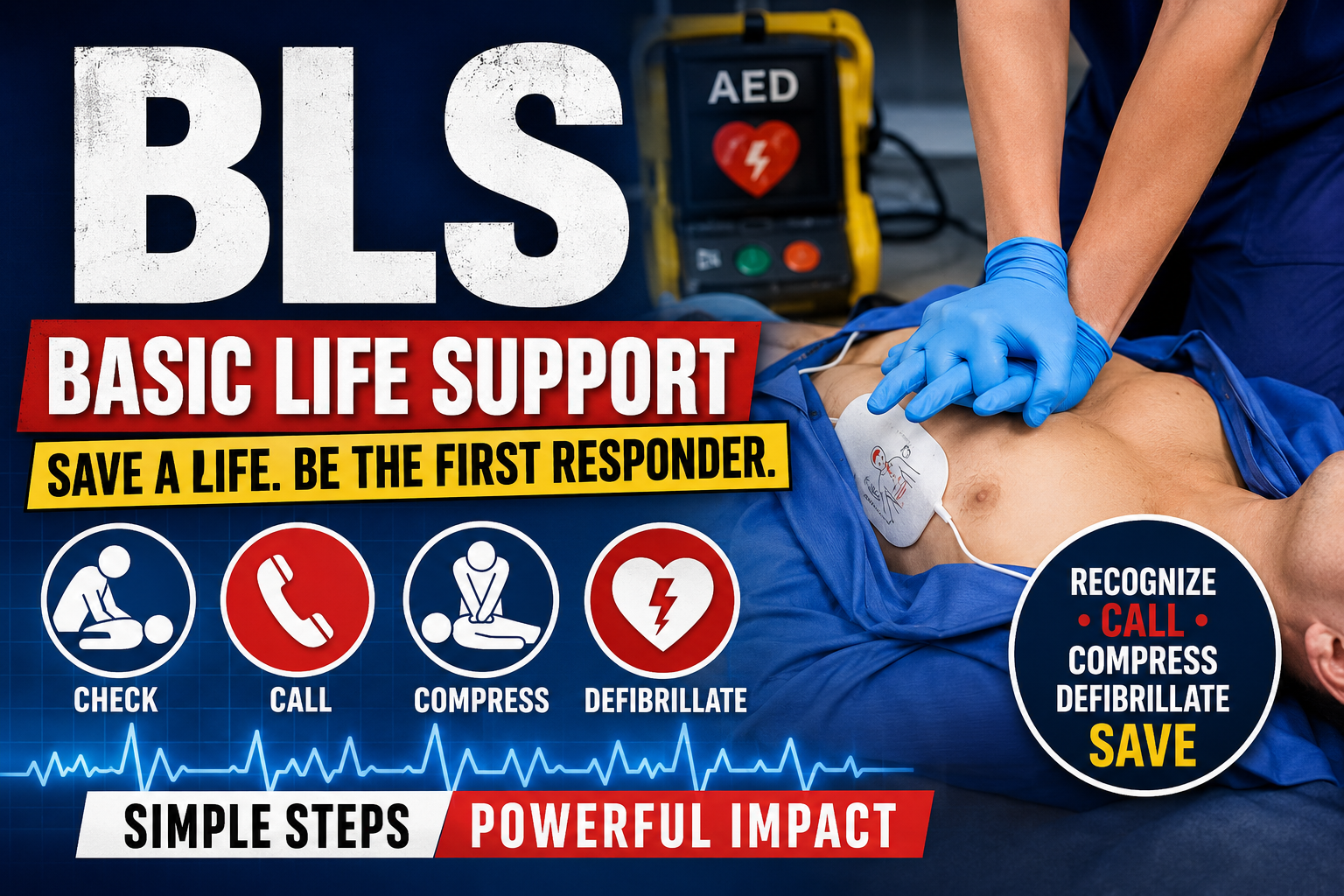
Recognize the emergency → activate help → start CPR → use an AED as soon as possible.
Step 1: Make Sure the Scene Is Safe
Before approaching the person, look around.
Is there:
Do not become the second victim.
If the scene is unsafe, move away and call emergency services.
If it is safe, approach the person.
Step 2: Check Responsiveness
Tap the person gently on the shoulders and speak loudly:
“Are you okay?”
If they respond, assess what is wrong and provide appropriate assistance.
If there is no response, you should immediately consider cardiac arrest.
Step 3: Check Breathing
Look for normal breathing.
A person in cardiac arrest may:
Agonal gasping is not normal breathing.
A person who is unresponsive and only gasping should be treated as being in cardiac arrest.
Do not waste valuable time trying to determine whether the person is breathing "well enough."
Step 4: Activate Emergency Medical Services
If an adult is unresponsive and not breathing normally:
Call your emergency response system immediately.
If another person is present, send them to call emergency services and bring an AED.
If you are alone, activate the emergency response system first and then immediately begin CPR, according to the 2025 AHA adult BLS recommendations.
In a real emergency, use your local emergency number.
Step 5: Start CPR
Place the person on a firm, flat surface if possible.
Position yourself beside the chest.
Place the heel of one hand in the center of the chest, on the lower half of the sternum. Place your other hand on top.
Keep your arms relatively straight and position your shoulders over your hands.
High-quality chest compressions
For an adult:
Rate: approximately 100–120 compressions/minute
Depth: approximately 5–6 cm (2 inches)
Allow the chest to fully recoil after each compression.
Avoid unnecessary interruptions.
The goal is not simply to "push on the chest."
The goal is to provide high-quality CPR.
What About Rescue Breaths?
For trained healthcare professionals and trained rescuers who are able and willing to provide ventilations, CPR should include both:
30 chest compressions : 2 breaths
Each breath should produce visible chest rise.
Avoid excessive ventilation.
Too much ventilation can be harmful and can interfere with effective chest compressions. The 2025 AHA guidelines specifically emphasize providing enough tidal volume to produce visible chest rise while avoiding both inadequate and excessive ventilation.
For an untrained bystander—or someone unwilling or unable to provide rescue breaths—hands-only CPR is still an important intervention while emergency help is being activated.
Step 6: Use an AED as Soon as Possible
An Automated External Defibrillator (AED) is designed to analyze the heart rhythm and determine whether an electric shock is appropriate.
When an AED arrives:
Turn it on.
Follow the voice/visual instructions.
Expose the chest.
Attach the pads as shown on the pads or device.
Allow the AED to analyze the rhythm.
Make sure nobody is touching the patient during analysis or shock.
If a shock is advised, deliver it.
Immediately resume CPR when instructed.
Do not delay CPR while waiting for the AED.
And do not be afraid of the AED.
You don't need to diagnose ventricular fibrillation yourself.
The AED analyzes the rhythm and tells you what to do.
Why Is Early CPR So Important?
When the heart stops pumping effectively, blood flow to the brain and other organs rapidly falls.
CPR provides a degree of artificial circulation.
It does not replace the heart.
But it can buy time.
The objective is to keep circulation going until spontaneous circulation can be restored, particularly through defibrillation when appropriate.
This is why:
Early CPR + early defibrillation = critical components of survival from cardiac arrest.
What If the Person Is Choking?
Severe choking is another emergency addressed by BLS.
A person with severe foreign-body airway obstruction may be unable to:
Speak
Cough effectively
Breathe normally
The 2025 AHA guidelines updated the approach to severe foreign-body airway obstruction.
For a conscious adult with severe choking, rescuers should alternate:
5 back blows → 5 abdominal thrusts
and continue until the obstruction is relieved or the person becomes unresponsive.
If the person becomes unresponsive, begin CPR and follow the appropriate emergency response algorithm.
What About Opioid Overdose?
The 2025 AHA BLS guidelines also incorporate naloxone into the management of suspected opioid-related respiratory or cardiac arrest.
If opioid overdose is suspected and naloxone is available, it may be administered according to the appropriate protocol.
However:
Naloxone should not delay CPR or activation of emergency medical services.
Common BLS Mistakes
1. Waiting for the person to "wake up"
An unresponsive person who is not breathing normally should be treated as an emergency.
2. Spending too long checking the pulse
For lay rescuers, prolonged pulse checks can delay CPR.
3. Starting with rescue breaths instead of compressions
If cardiac arrest is suspected, begin effective chest compressions promptly.
4. Compressing too slowly
Remember:
100–120/minute.
5. Not compressing deeply enough
Adult compressions should be approximately 5–6 cm deep.
6. Leaning on the chest
Allow complete chest recoil between compressions.
7. Excessive ventilation
More air does not necessarily mean better CPR.
Avoid hyperventilation.
8. Being afraid to use an AED
Modern AEDs are designed to guide rescuers through the process.
BLS Is Not Just CPR
Many people think BLS means:
"Do 30 compressions and 2 breaths."
That is only part of the picture.
Effective BLS begins with:
Recognition
↓
Activation of emergency response
↓
High-quality CPR
↓
Rapid AED use
↓
Continuation of resuscitation until advanced care arrives
The 2025 AHA guidelines emphasize this broader system of response rather than viewing CPR as an isolated procedure.
The Most Important Message
You don't need to be a doctor to save a life.
You don't need an ICU.
You don't need an advanced airway.
You don't need an ECG.
You need to recognize that something is seriously wrong and act quickly.
If an adult collapses, is unresponsive and is not breathing normally:
Call for help.
Start CPR.
Get an AED.
Follow the AED instructions.
Keep going until help takes over or the person shows signs of life.
BLS is simple enough to learn—but powerful enough to save a life.
And in cardiac arrest, doing something quickly is far better than standing by and doing nothing.
Key BLS Numbers to Remember
| Component | Adult BLS |
|---|
| Chest compression rate | 100–120/min |
| Compression depth | ~5–6 cm |
| CPR ratio when providing breaths | 30:2 |
| AED | Use as soon as available |
| Severe choking, conscious adult | 5 back blows + 5 abdominal thrusts |
These figures reflect the 2025 AHA recommendations; clinical training should follow the complete current guideline and local protocols.
Final Takeaway
Recognize. Call. Compress. Defibrillate.
Because when the heart stops, every minute matters.